
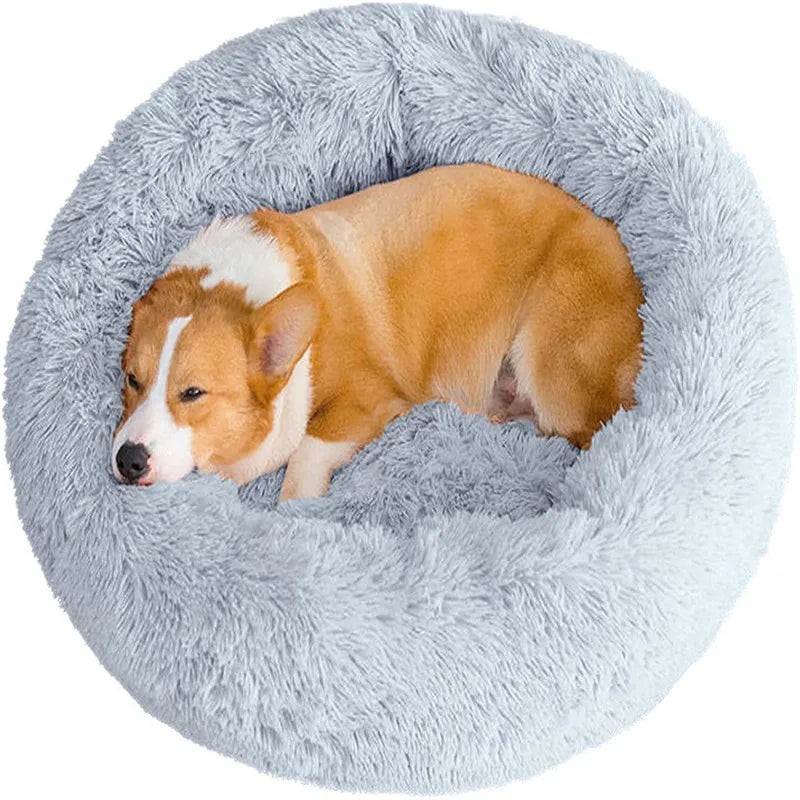
A bed that is too small gets ignored, and one that is far too big can feel exposed, especially for dogs who like to curl up. The good news is that choosing the right size takes about two minutes and a tape measure.
Step 1: Measure your dog
Wait until your dog is lying down in their usual sleeping position, then measure:
- Length: from the tip of the nose to the base of the tail.
- Width: across the widest part of the body while they are lying down. If they sprawl on their side, measure from paws to spine.
Then add 15 to 25cm to the length. That extra room lets your dog turn around, stretch a little and settle without hanging off the edge. For puppies, size up for the dog they will become, or plan to replace the bed as they grow.
Step 2: Match the bed to how your dog sleeps
Size is only half of it. The shape matters just as much.
- Curlers sleep tucked into a ball with their nose near their tail. They usually prefer a round bed with raised sides to lean against. A curler can often use a slightly smaller bed than their stretched-out length suggests.
- Sprawlers stretch out on their side or back. Go for the full measured length plus extra, and choose a flatter bed or mat with low or no sides.
- Burrowers and nervous dogs like to feel enclosed. A covered, house-style bed gives them a den to retreat to.
- Dogs that run hot, such as thick-coated breeds or older dogs in summer, often move off soft beds onto cool floors. A cooling mat gives them a comfortable alternative.
Dog bed size table
Use your measured length (nose to base of tail) to find a starting size. The breed examples are typical only, so always go by your own dog's measurements.
| Your dog's length | Look for a bed around | Typical examples |
|---|---|---|
| Up to 40cm | 50 to 60cm | Toy breeds, small puppies |
| 40 to 55cm | 60 to 70cm | Small terriers, small spaniels |
| 55 to 70cm | 80 to 90cm | Medium breeds such as beagles |
| 70 to 85cm | 100cm | Larger medium to large breeds |
| 85cm and over | 110cm or a large flat bed | Large breeds such as retrievers |
If your dog falls between two sizes, choose the larger one for sprawlers and the smaller one for dogs who curl up tightly.
Which Pet House bed fits which dog?
- Round Plush Pet Bed: deep, soft plush with a raised rim, made for curlers. Seven sizes from 40cm to 110cm across, so it covers everything from small dogs to large breeds.
- Plush Basket Bed: a cushioned basket with deep walls in five sizes, from S (45 x 30cm) to XXL (80 x 60cm). A good choice for small and medium dogs who like something to lean on.
- All-Season Dog House Bed: an enclosed bed with a removable, washable cover, in S, M and L, for dogs who want a den.
- Cooling Ice Bed: a self-cooling mat in M, L and XL for warm days and dogs who sprawl.
Each product page lists the exact dimensions for every size. You can browse them all in our dog beds and houses collection.
A few practical tips
- Check the inside measurement. On beds with raised sides, the flat sleeping area is smaller than the outside diameter.
- Think about where it will go. Measure the corner or crate where the bed will sit before you order.
- Keep it washable. A removable or machine-washable cover makes it much easier to keep the bed fresh.
- Older dogs may find it easier to step onto a bed with a low front edge.
Frequently asked questions
Should a dog bed be bigger than the dog?
Yes. Aim for roughly 15 to 25cm longer than your dog's nose-to-tail length so they can turn and stretch. Dogs that curl up tightly can manage with a little less.
What if I order the wrong size?
Every Pet House order comes with 30-day returns, so if a bed is not right you can send it back unused. See our refund policy for details.
How quickly will it arrive?
UK delivery is free on every order. Most orders arrive within 4 to 7 business days.