
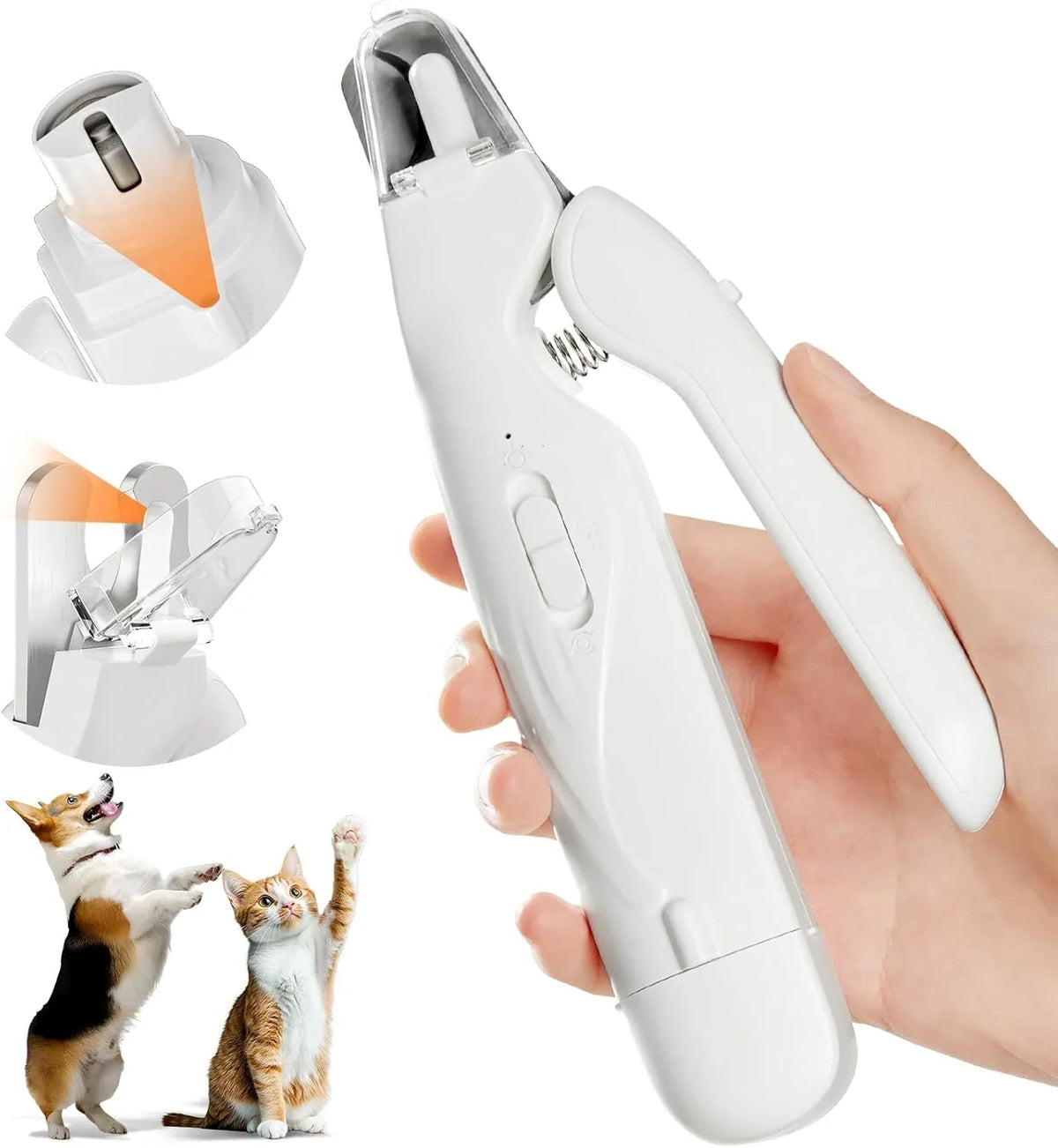
Quick answer: clippers are faster and silent, so they suit calm dogs with thin nails and quick trims. Grinders are slower but take the nail down gradually and leave a smooth edge, which makes it easier to avoid the quick, especially on thick or dark nails. Many owners get the best of both by clipping the length first, then grinding to smooth the edge.
Side-by-side comparison
| Clippers | Grinder | |
|---|---|---|
| Speed | Very quick, one cut per nail | Slower, a few seconds per nail |
| Risk of cutting the quick | Higher, as each cut takes off more at once | Lower, as you remove thin layers and can check as you go |
| Finish | Can leave sharp or rough edges | Smooth, rounded edges |
| Noise and vibration | Silent, just a click | Motor noise and vibration |
| Thick or dark nails | Harder to judge and can crack the nail | Easier to control |
| Power | None needed | Needs charging |
| Learning curve | Quick to learn, but mistakes hurt more | Pets may need time to get used to the sound |
When clippers are the better choice
- Your dog is calm about having their paws handled.
- Their nails are thin and light-coloured, so you can see the quick.
- You want a fast, quiet trim.
- Your dog is very sensitive to noise or vibration.
When a grinder is the better choice
- Your dog has thick or dark nails where the quick is hard to see.
- You're nervous about cutting too short.
- You want smooth edges that won't scratch skin, floors or furniture.
- You keep nails short with little-and-often touch-ups.
Why many owners use both
Clipping takes off most of the length quickly, then a few seconds with a grinder smooths the edge and lets you take the nail a little closer to the quick with more control. A 2-in-1 tool saves switching between two. Our 2-in-1 Pet Nail Clipper & Grinder has a clipper with a safety lock, a low-noise grinder with three ports for different pet sizes, and a built-in LED light that makes the quick easier to see. It's rechargeable and comes with a storage bag and cleaning brush.
What about cats?
Most cats only need the sharp tip of each claw trimmed. Small clippers are usually quickest for cats, but a quiet grinder works well for cats who tolerate the sound. Keep sessions very short and do a few claws at a time.
Tips for either tool
- Get your pet used to having their paws handled before you trim.
- Work in good light, and stop before the pink quick or, on dark nails, the dark dot in the centre of the cut surface.
- Reward often and keep sessions short. One paw a day is fine.
- Keep styptic powder or cornflour nearby in case you nick the quick.
Our step-by-step guide to trimming your dog's nails with a grinder walks you through a full session.
Frequently asked questions
Is a nail grinder safer than clippers?
It's generally easier to avoid the quick with a grinder, because you take off thin layers and can check as you go. Either tool is safe when used carefully.
Do nail grinders scare dogs?
Some dogs are wary of the noise at first. Introducing the grinder slowly, with treats, and choosing a low-noise model helps most dogs get used to it.
How often should I trim my dog's nails?
Most dogs need a trim every few weeks. If you can hear their nails clicking on hard floors, it's time.
Can I use human nail clippers on my dog?
It's not recommended. Human clippers are designed for flat nails and can crush or split a dog's rounded nail.
Browse brushes, nail tools and more in our grooming and care collection. UK delivery is free on every order.